Coaching
is a form of leadership that sets goals and encourages the growth of a team to
succeed. A team should be built upon exciting learning experiences, the
cultivation of productive habits, cooperation,
and enthusiasm. Using robotics as a vehicle for the promotion of this learning
environment can carry a tech-ed classroom to a level of greatness that Wooden
describes in his book On Leadership. In
this book he tells his story of coaching his UCLA basketball team to a level of
greatness reached by no other team in the league. Wooden lays the groundwork
for a roadmap that he spent an entire coaching career to develop. This guide he
calls the Pyramid of Success is built upon a bedrock of industriousness,
friendship, loyalty, cooperation,
and enthusiasm. The next level of his pyramid contains four pillars of
self-control, alertness, initiative, and intentness. This is followed by skill,
condition, and team spirit, but to reach the top of the pyramid a team must
also be fostered to develop confidence in their abilities and maintain an
intensity of poise. Once all of Wooden's cornerstones were stacked in a sturdy
pyramid fashion his team was able to reach the level of competitive greatness
that inspired him to share his experiences through the writing of this book. An
educator can draw many parallels between a classroom environment and the
building of Wooden's competitive sports team. Developing a sense of Team in the
classroom can create a more inclusive learning environment especially through
the participation of the many robotics competitions now available to tech-ed
teachers.
Student
motivation in the Technology
classroom requires the facilitation of an effective network of choice-based
learning opportunities. An educator can shape STEM learning into an
intrinsically rewarding experience through various activities involving
robotics and competitive events. By providing students with the tools they need
and coaching them through challenging learning activities an educator can alter
the students’ perceptions of the seemingly extrinsic values of STEM based
curriculum. Because robotics branches
out to so many disciplines it can connect with curricula outside of the tech-ed
classroom. The complexity of creating a functional robot requires a great deal
of teamwork and provides opportunities for students to demonstrate leadership
and compete in a content area outside of physical strength, agility, and
coordination, providing a truly unique learning experience for students.
Parsing
through the characteristics of motivated and amotivated students, educators can
more effectively coach their students towards greater achievement. Public education teachers are the captors of
their student audience, and students have little choice in how they spend their
time at school. This inherent trait of our American education system factors into
many cases of amotivation and low achievement in schools. It takes a carefully crafted classroom environment, in addition to
engaging learning experiences in order to create motivation within the student
to achieve their goals.
Enthusiasm
in the tech-ed classroom can come from a teacher who is genuinely interested in
the subject area and is excited to share their experiences with the class.
Guest speakers are a great way to demonstrate enthusiasm for an educator's
content area. Giving students the opportunity to meet an adult with a career in
their field of study proves the relevance and reality of their learning
experiences. Some students will greatly appreciate the various competitive
program events of Lego, VEX, FIRST, etc. while others will be inspired by
various open-source hacker-style robotics projects.
A
technology educator can keep students enthusiastically engaged in robotics
through the use of long-term projects. One important tactic in helping students
successfully complete their project is by suggesting goals for various team
members/students and helping classmates effectively coordinate their efforts
with each other. Involving students in the scheduling of deadlines and various
forms of assessment keeps their skin in the game and allows them to meet personal
deadlines and reflect on their progress throughout the semester.
The
enthusiasm of students to boldly
adventure into the realm of creator confronts them with a test of patience,
resourcefulness, and planning abilities as they work towards the completion of
a project. Navigating through the design process as a team develops student's
interpersonal relationships and helps them validate the interconnectedness of
science technology engineering and math as they draw upon prior knowledge and
experiences of their other core content classes, hobbies, guest speakers, and
internet resources. All of these skills are essential in any career, leadership
position, or personal endeavor.
Skill
development can be coached by a robotics instructor
because the study of robotics requires students to develop countless skills in
problem solving, design, understanding of simple machines, electronics,
programming, teamwork, math, engineering, systems integration and countless
other relative fields of study. The cultural, social, economic, and political
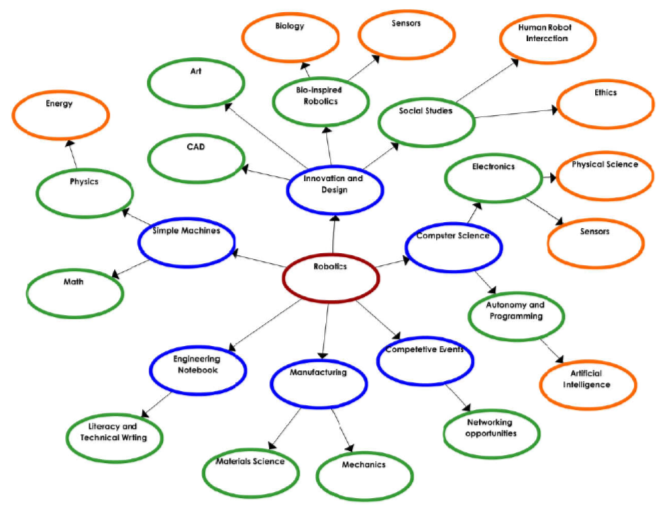
effects of technology can also be studied through lessons and class discussions on robotics. See Fig. 1
for a map of different subjects that robotics incorporates.
The
ultimate goal in a technology classroom is to promote technological literacy.
The ITEEA's standards for technological literacy can be explored through the
incorporation of robotics in the tech-ed curriculum. The future our society is
running towards is inevitably accelerating into a faster-paced world of
technological progress and achievements built upon the previous generation's
technological advancements. Artificial intelligence, automation, the internet,
and our ability to expand the computing power of semiconductors into ever
smaller circuits will surely create a technological ecology where robotics will
flourish. This relatively new field of study is a great launching point from
which to study the ideas expounded in the STL. No one knows exactly what the
future will bring but the present trends indicate that robotics will play an
extending role in the future of developed societies. Wooden's perspective on
the human struggle towards competitive greatness has a far-reaching relevance when
compared to this aspect of our technological future. By enthusiastically engaging
students of technology with robotics they will develop the skills to be better
prepared and motivated to actively shape their future society in much the same
way Wooden was able to coach his UCLA basketball team to the top of their game.